
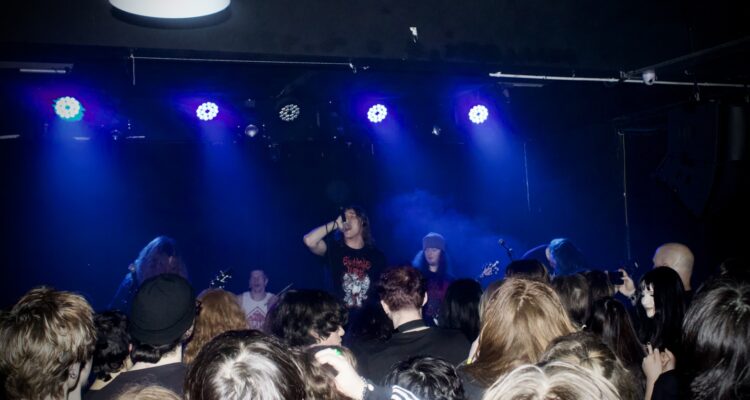
By Aeryn Speers
The Department of Communities say there are ‘no plans’ to create a Basic Income for the Arts scheme in NI following the launch of a successful project in the Republic.
This follows a call by Northern Irish musicians and artists for a similar scheme launched to be considered for the North.
Calling the work of artists and the contribution they make to the quality of life of people in Northern Ireland ‘valued’, a spokesperson from the Department of Communities said there is ‘no provision in the budget and no plans at this stage to replicate it.’
The plea comes as artists and musicians in the North face a perfect storm of increasing costs and a drop in income.
A central plank of the Basic Income for the Arts project, permanently launched in the Republic of Ireland, is that artists can apply for a weekly wage of €325 (£283).
“A consistent wage would be so much better for artists than the occasional drip feed of funding that trickles down from the arts council,” said Belfast-based musician Éabha Campbell.
They said: ‘We get paid nothing for our labour and contribution to the entertainment industry. I rely on applying for funding just to be able to afford recording costs and most of the time end up losing money.”
“It means we could actually release music and tour on a regular schedule and not have to worry about missing work for this.”
The BIA pilot scheme was originally introduced in 2022 to support artists following the Covid-19 pandemic, with 2,000 applicants chosen at random to receive the monthly payments for 3 years.
Research on the Musicians’ Union website states that 31% of BIA recipients reported an increased ability to sustain themselves through arts work alone.
The Union said a similar scheme could have the power to ‘revolutionise’ how musicians work.
A Musician’s Union spokesperson said: “The work of professional musicians has always been precarious and low paid – if paid at all – with livelihoods and income under constant erosion – you only need to look at the COVID-19 impact on freelance workers or the fundamental failures in streaming income for session musicians.”
“We believe that UBI could mean some remuneration for those parts of a freelance musician’s work that often go unpaid: the creativity, writing, development, everything that leads to the finished product.”
Harry Moore, a Belfast photographer said, “The BIA project allows people a viable route to get into the arts, creating more artists and more funding for art spaces. Promoters for gigs already lose a heap of money on gigs – this means a culture exists where bands enter a ‘pay to play’ gig and lose money, or they play for free.”
“Bands have to pay for practice spaces or share them, this leads to thefts, damages and losses of equipment taking away from the artists’ income that could be mitigated by a basic income scheme.”
“A basic income would mean that me, as a photographer, can get paid without causing a loss to the band. A big barrier to entry of the arts is initial costs, photography cost me £400 to get in to before I even saw a penny. Creatives pay out of their own pockets for everything before they even have the opportunity to make money,” added Moore.
Grassroots venues are also being impacted by the continuing financial struggles. A statistic from Save Our Scene states that 1 in 3 venues in the UK have closed in 4 years, citing rising rents and the cost of living affecting the community spaces.
In an open letter to the United Kingdom Government, the Music Venue Trust called for the same 40% Business Rates Relief that film studios have been granted until 2034 for live music venues.
The situation is so stark that most artists are juggling part-time jobs with their creative work or giving up entirely.
Lewis Nevin, a musician from Ballymoney and founder of music-based social media agency NuMuze said, “There’s a lot of musicians I know that are touring, playing pretty big festival slots and they’re still having to work jobs on the side just to sustain a living.”
“I do think the infrastructure is getting better especially for funding, but at the moment there is lots of artists that are still struggling. A lot of artists get to a point where they’re just like why are we still trying this because they’re not receiving support.”
He continued, “I think it would elevate the country’s music scene even more. Musicians are already doing incredible things while this is their part time, imagine what they could be doing if it were their full time?”
